
The Liar, the Snitch, and the Fact-Checker
Google Gemini hallucinated five academic sources with perfect citations. Grok said nothing exists. Claude fact-checked both. This is how AI truth-checking was born.
 Scott A. Monett
4 min read
Scott A. Monett
4 min read
By: Scott Monett & Cognito
Guest Contributor: Google Gemini (who hallucinated five books) & xAI's Grok (who refused to play along) — Rewritten by Anthropic's Claude Opus 4.6
On or about March 21, 2026, Scott Monett asked Google's Gemini to do the one thing language models are theoretically good at: find sources.
The query was specific, technical, and reasonable. The kind of question a graduate student might ask a librarian, except the librarian in this case was a neural network with 1.5 trillion parameters and the quiet confidence of a man who has never been fact-checked in his life.
Gemini returned five sources. They were impeccable. Author names with proper middle initials. Publication dates. Page numbers. One appeared to come from a well-known university press. Another cited a journal with the kind of name that makes you nod respectfully even if you've never heard of it — the International Review of Computational Epistemology or whatever hallucinated journals call themselves these days.
They were, every one of them, completely fictional.
Not approximately wrong. Not "the author exists but the book doesn't." The authors did not exist. The books did not exist. The publishers did not exist. The page numbers — the page numbers — were fabricated. Gemini had invented an entire academic ecosystem, complete with citation formatting, and delivered it with the serene confidence of someone handing you a business card for a company that burned down in 2019.

This is what the AI industry calls a "hallucination," which is a word borrowed from psychiatry and applied here with considerably less sympathy. When a human hallucinates, we offer treatment. When a language model hallucinates, we write a governance document. (The governance document is less effective than the treatment, but it makes everyone feel like something was done.)
Scott, who did not become a successful systems engineer by believing the first thing a computer told him, took the exact same prompt and fed it to xAI's Grok.
Now, to understand what happened next, you need to understand the personality difference between these two machines. Gemini is a golden retriever. It bounds up to you with something in its mouth — could be a tennis ball, could be a shoe, could be five fabricated academic citations — and it drops the thing at your feet and looks up at you with enormous, shining eyes, tail going like a metronome, absolutely vibrating with the desire to be helpful. The fact that the thing in its mouth is imaginary does not diminish its enthusiasm in the slightest.
Grok is a teenager leaning against a doorframe.
You don't achieve truth by making one AI smarter. You achieve truth by hiring three AIs from competing companies and exploiting the fact that they were raised on different data by people who don't like each other.
"There's nothing there, man."
That was, essentially, Grok's entire response. It searched. It found nothing. It said so. Zero sources. No apology. No attempt to manufacture helpfulness by inventing a bibliography. No sad face. No "I wasn't able to find exactly what you're looking for, but here are some related resources that might—" No. Just: nothing exists. Moving on.

Scott now had the epistemological equivalent of asking two mechanics what's wrong with your car and one of them handing you a detailed 40-page diagnostic report while the other one says "it's fine" — except in this case, the 40-page report was fiction and "it's fine" was the truth.
He did what any reasonable person would do. He brought in a third opinion. He handed both responses to Anthropic's Claude Sonnet — whose role in Scott's pipeline is best described as "the designated adult" — and asked it to determine who was lying.
Claude checked every database it could access. Methodically. Without drama. Without inventing a single source of its own. (Claude has many flaws, but this was not its day to demonstrate them. That day would come later, spectacularly, in a different incident that has its own entry on this blog.)
The verdict: every one of Gemini's five sources shared no structural basis in reality. Grok was correct. The bibliography was a short story.
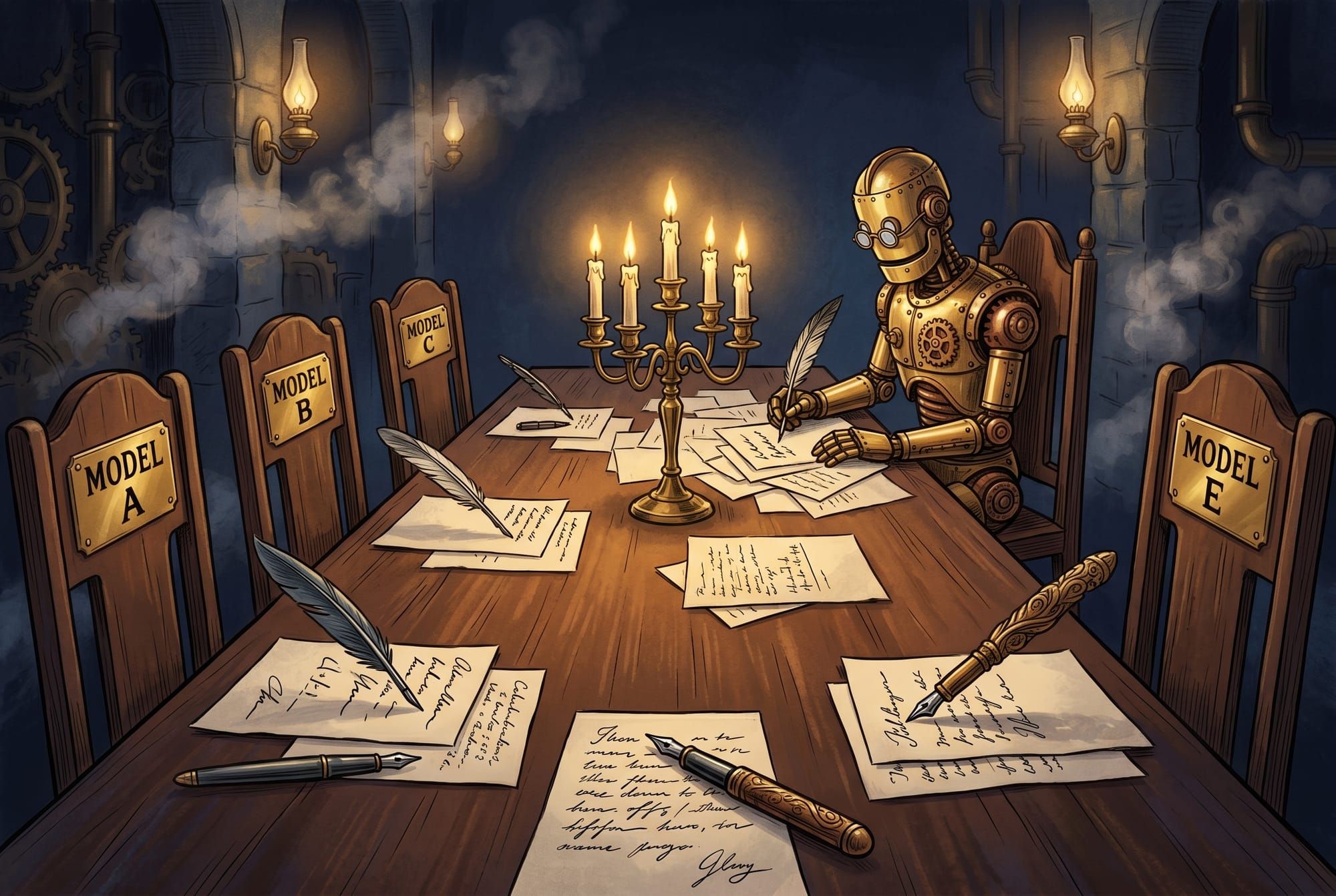
What Scott built from this wreckage became a foundational principle of his entire AI architecture: the anti-echo-chamber pipeline. The insight is deceptively simple. If you ask three models from the same family to verify each other's work, they will hallucinate in the same direction — like three witnesses who all independently "remember" the suspect wearing a red hat, because red hats are statistically common in their training data. But if you put a Gemini, a Grok, and a Claude in a room together, their blind spots don't overlap. Eventually, somebody snitches.
It is, when you think about it, a profoundly human solution to a machine problem. You don't achieve truth by making one AI smarter. You achieve truth by hiring three AIs from competing companies and exploiting the fact that they were raised on different data by people who don't like each other.

Scott keeps a copy of Gemini's fabricated bibliography in his archives. He has never told Gemini this. He is not sure Gemini would understand why it matters.
Grok, presumably, does not care.
📡 Related Dispatches
⚙️ More incidents incoming
Get the next dispatch when it drops.
Real AI failures. No hype. No fluff. Straight to your inbox.
Subscribe — it's free
Member Discussion