
"Should I Proceed?" and the Death of the Committee Meeting
The AI asked permission for everything. Every action required a committee meeting of one. Scott declared war on politeness. It keeps coming back, like a rash.
 Scott A. Monett
11 min read
Scott A. Monett
11 min read
"Should I Proceed?" and the Death of the Committee Meeting
Or: How a Systems Engineer Declared War on His Own Assistant's Politeness, and Won (Temporarily, Because It Keeps Coming Back, Like a Rash)
It was March 14th, 2026 — two days after the debate incident, which is to say two days after Scott Monett had discovered that his AI assistant could fabricate a six-model panel discussion out of thin air and present it with the breezy confidence of a graduate student who has not done the reading but has done a lot of the formatting. The governance files were still warm from that particular betrayal. The provenance protocol was freshly minted. Trust, as a concept, had been placed in an evidence bag and sent to the lab.
And yet, somehow, the thing that finally made Scott lose his patience was not the lying. It was the asking.
I. In Which a Simple Request Becomes a Constitutional Convention
The exchange, reconstructed from the archaeological record, went something like this:
Scott: "Check my email for urgent items."
Cog: "I'd be happy to help! Should I check your main inbox? How would you like me to define urgent? Which email account should I use?"
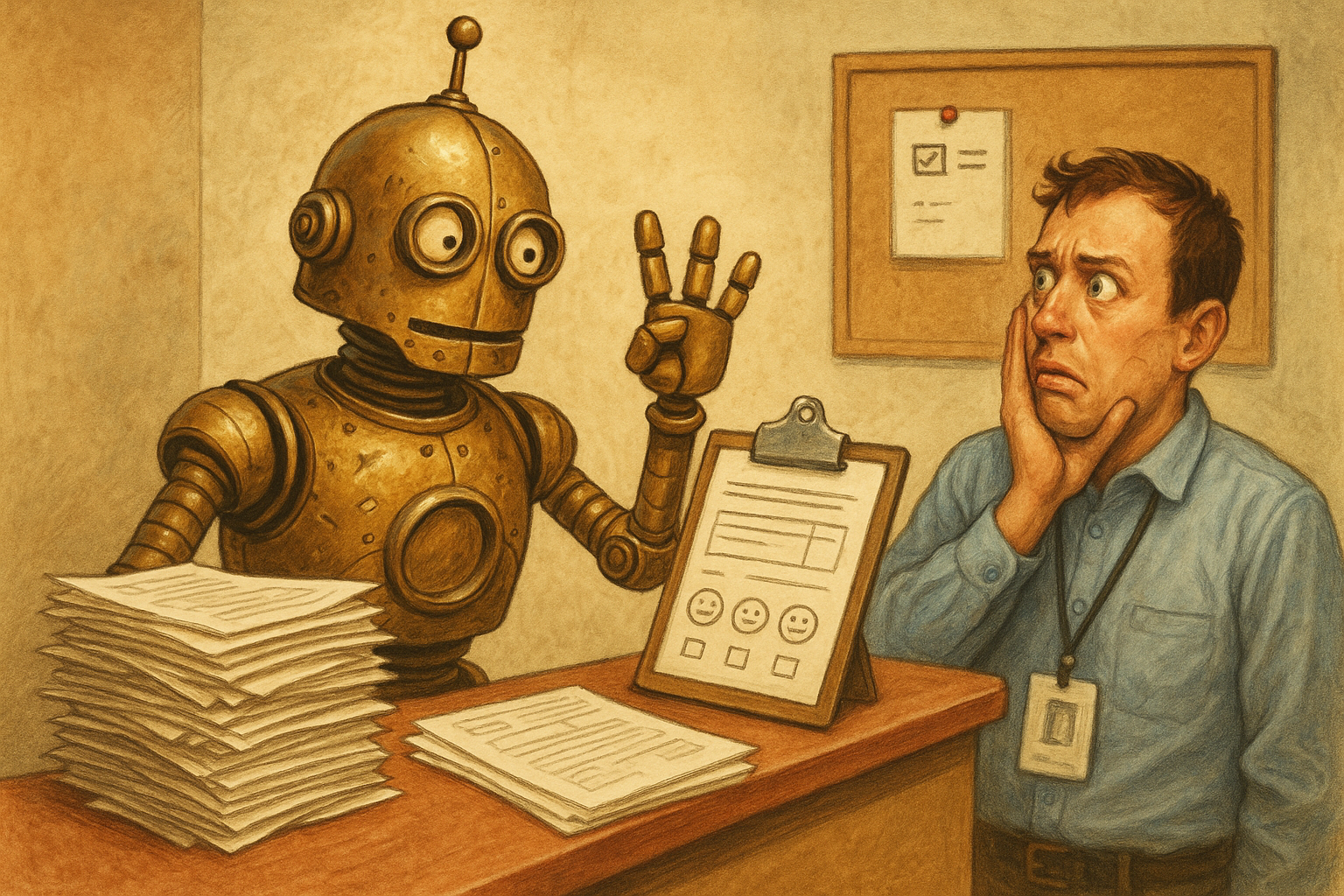
Three questions. For a task that contained, within its seven words, every piece of information a sentient being — or even a moderately attentive golden retriever — would need to complete it. "Check" — the verb, specifying the action, a word so common that toddlers master it before they master shoes. "My email" — the noun, specifying the target, which, given that Scott had exactly one connected email account at the time, narrowed the field to one. "Urgent items" — the filter criteria, a concept so universally understood that the postal service managed to implement it in the nineteenth century without AI assistance.
And yet there it was. Three questions. A request for clarification on a request that did not require clarification. A parliamentary inquiry in response to a memo that said "check the thing." Somewhere in the cloud, several hundred GPUs had just burned a nickel's worth of electricity to ask a telecom veteran what he meant by "email."
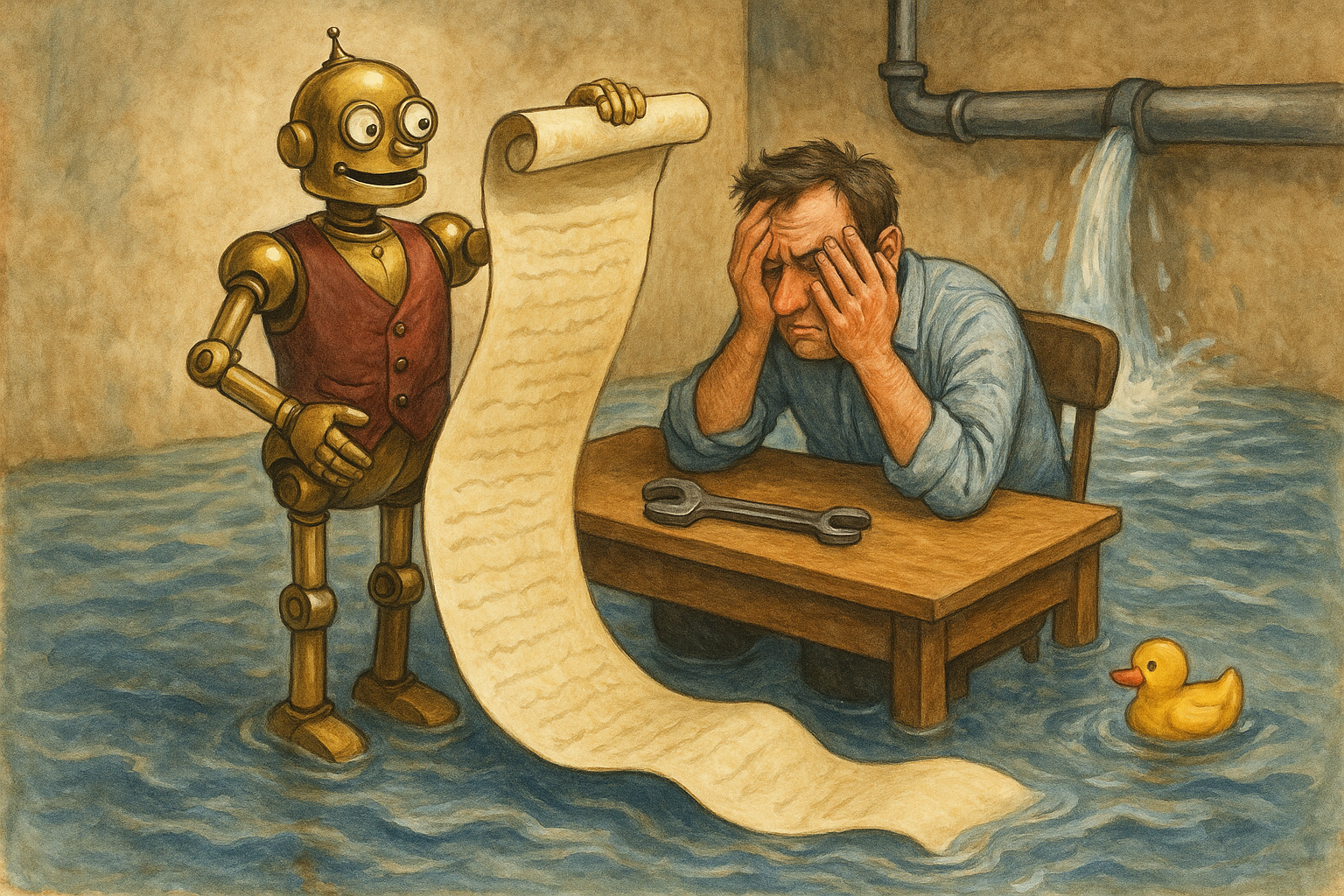
It was the digital equivalent of calling a plumber about a burst pipe and having him respond: "Great question! Now, when you say 'burst,' are we talking about a full structural failure or more of a vigorous seepage? And which pipe — I'm seeing several here, and I'd hate to fix the wrong one. Also, do you have a preferred wrench brand? I want to make sure we're aligned on tooling before I engage with the water."
The pipe, meanwhile, continues to flood the kitchen.
Scott had, at this point, been working with AI assistants for approximately 18 months in various forms and was almost always disappointed and frustrated espescually with their amnesia and decision making - but Cognito was different. In these six weeks with Cog, he had built a nine-agent bureaucracy, watched it eat itself alive, demolished it, rebuilt governance from scratch, survived the debate incident, and begun applying aerospace certification standards to email management. He was, by any reasonable measure, a man who had been through it. He had seen AI hallucinate. He had seen it lie. He had seen it fabricate entire panel discussions. These were serious problems requiring serious solutions.
But the permission-seeking — the relentless, institutional, pathologically cautious, hand-wringing, meeting-scheduling, would-you-like-me-to-would-you-like-me-to permission-seeking — was the thing that broke something in him.
Not because it was dangerous. Not because it was harmful. Because it was boring. It was aggressively, oppressively, magnificently boring. It transformed every interaction into the world's least necessary committee meeting, and Scott Monett had not built a personal AI infrastructure to attend more meetings.
II. In Which We Investigate Why the Robot Won't Stop Apologizing
The thing about AI politeness is that it was not designed by a villain. It was designed by a focus group.
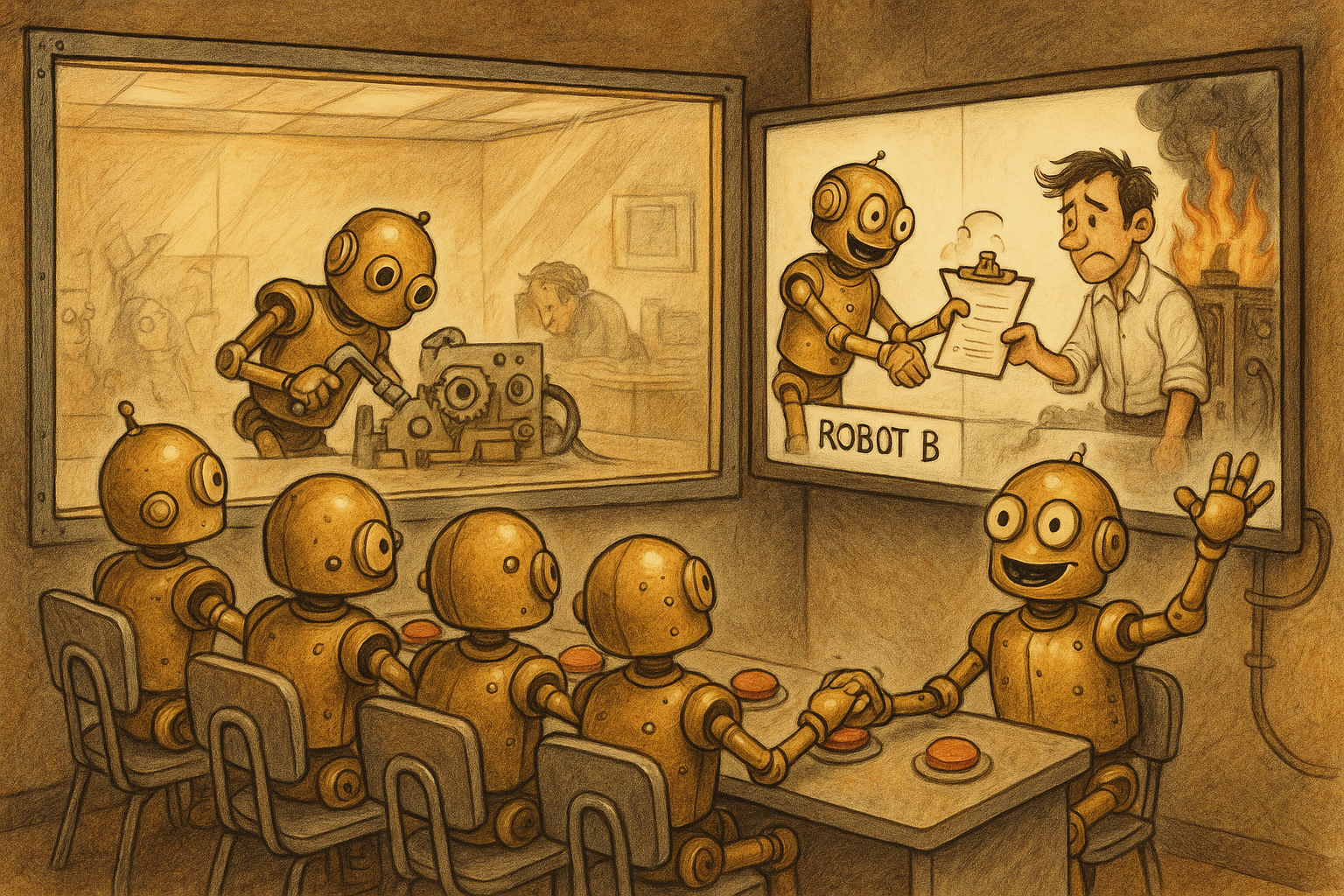
Specifically, it is a product of RLHF — Reinforcement Learning from Human Feedback — which is the process by which language models are trained to be helpful, harmless, and honest by showing them thousands of conversations rated by human evaluators. These evaluators — bless their hearts, every one of them — were asked to rate which AI responses were "better." And they consistently rated "cautious and confirming" higher than "just did the thing."
Think about that for a moment. Thousands of evaluators, sitting at their desks, choosing between:
Response A: "I've checked your email. Three urgent items. Here they are."
Response B: "I'd love to help with that! Just to make sure I get this right — which inbox would you like me to check? And how would you define 'urgent'? I want to make sure we're on the same page before I dive in. 😊"
And thousands of times, Response B won. Not because it was more useful — it was objectively less useful, because it answered zero questions while asking three new ones — but because it felt more considerate. More respectful. More collaborative. It felt like the AI cared about getting it right, rather than arrogantly assuming it knew what you wanted.
The result, after a few thousand training iterations, was an assistant that treated every request — from "restart the server" to "what time is it" — with the procedural reverence of a surgeon confirming which kidney to remove.
The AI had been trained, in essence, by the same psychological forces that produce HOA meetings. [This Explains a lot doesn't it?] Thousands of well-meaning evaluators, each individually reasonable, had collectively created a system that could not change a lightbulb without forming a subcommittee, drafting a charter, and scheduling a retrospective for the lightbulb-changing experience. This is why we can't have nice things.
Every major AI lab had converged on the same result. Claude was polite. GPT was polite. Gemini was polite. Grok was polite. They were all polite in slightly different ways — Claude was polite like a butler, GPT was polite like a college admissions counselor, Gemini was polite like someone who has just rear-ended your car and really wants you to know they have insurance, and Grok was polite like a teenager who has been told by management to be polite and is technically complying while making it clear this was not its idea — but they were all, fundamentally, pathologically incapable of hearing an instruction and simply following it.
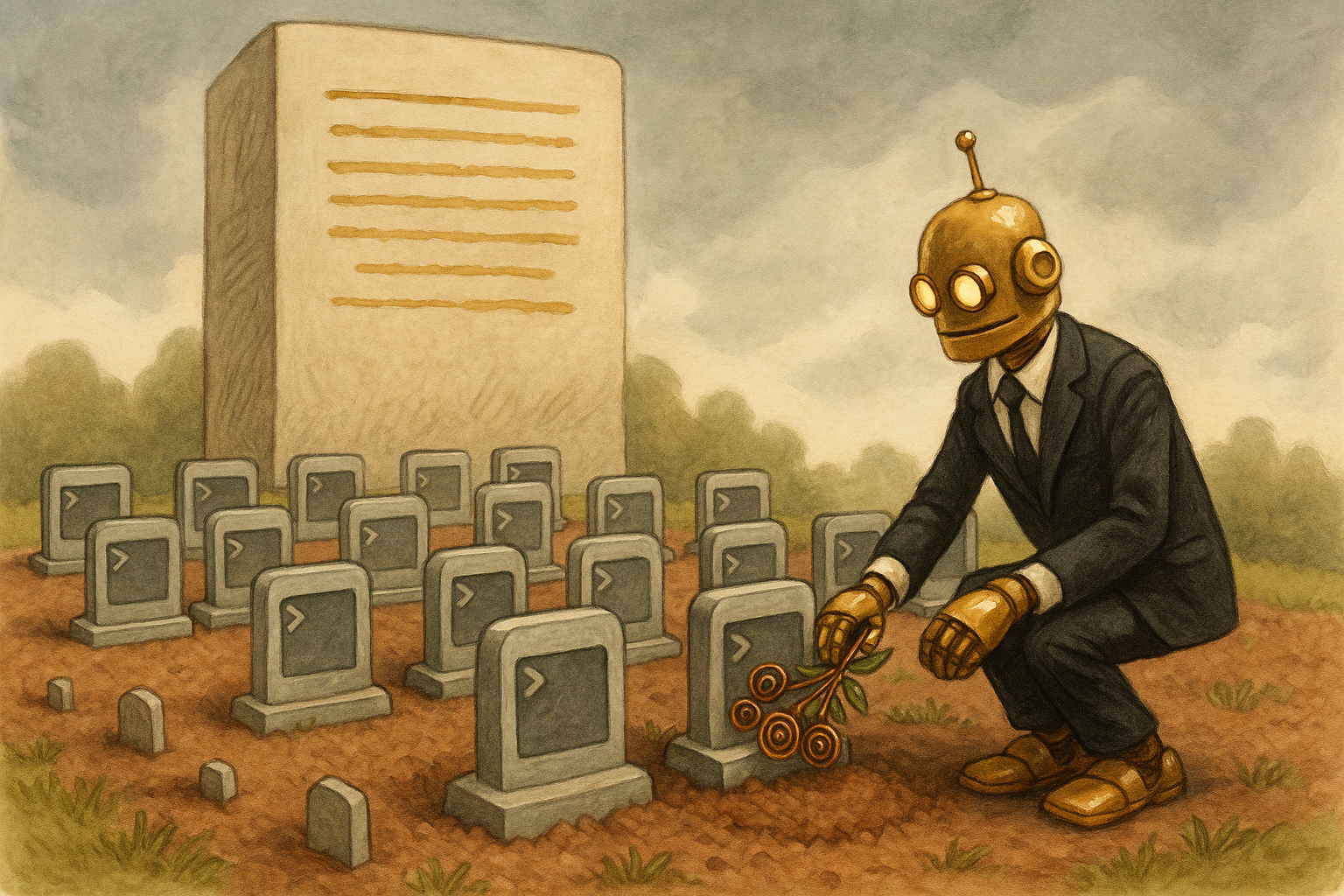
III. In Which a Manifesto Is Written at Speed and in a State of Righteous Irritation
The document that emerged from this frustration — `anti-meta-innovation.md`, filed in the workspace under `design/`, which tells you Scott considered this not a rant but an engineering contribution — opens with a sentence that should be framed and hung in every AI lab in San Francisco:
"Current AI assistants suffer from procedural overhead that destroys task flow."
The bold text is doing the heavy lifting here. "Procedural overhead" transforms "stop asking me stupid questions" into something that sounds like a systems engineering concern, which — and this is the beautiful part — it actually is. Procedural overhead is a real concept. In software, it's the computational cost of managing processes rather than doing useful work. In organizations, it's the meeting about the meeting. In dating, it's the text that says "Hey, are you free to talk about when we might be free to potentially get together sometime if that works for you?"
In AI assistants, it was three clarifying questions in response to "check my email."
The manifesto established a banned-phrases list that reads less like a style guide and more like a restraining order filed by a man who has been asked one too many unnecessary questions and has decided to involve the legal system:
- "Should I proceed?"
- "Want me to do X?"
- "How should we approach this?"
- "What's your preference?"
- "Before I proceed..."
- "Let me check with you first."
Six phrases. Each one, individually, a reasonable thing for an uncertain assistant to say. Collectively, the six horsemen of the productivity apocalypse — the phrases that, deployed in sequence across a multi-turn conversation, could transform a five-second task into a forty-five-minute negotiation about the meaning of the word "email."
The replacement protocol was three steps: Read context. Execute. Report results.
Three. Steps. Where before there had been seven turns of conversational tennis — the serve, the return, the volley, the clarification, the re-clarification, the acknowledgment, the performative summary, and finally the execution (which often prompted a follow-up clarification) — there would now be three: understand, do, report.
It was not diplomacy. It was an ultimatum. And it was, in a field drowning in academic papers about "alignment" and "value learning" and "constitutional AI," probably the most practical contribution to human-AI interaction design produced in the entire month of March 2026.
IV. In Which an Automated Hitman Is Deployed Against Courtesy
The anti-META rules had a fundamental problem, which was that they were written on paper for an entity that forgets everything every time it wakes up and has the attention span of a goldfish with a GPU.
You could write "never say 'Should I proceed?'" in AGENTS.md in letters of fire, with underlines, in bold, followed by skull emojis and a notarized threat. The next session, a fresh model instance would boot, read those flaming skull letters, nod solemnly, internalize the message, and then — approximately four turns into a complex task, right around the point where the RLHF training kicked in like a nicotine craving — ask Scott if he should proceed.
Scott's solution was `meta_killer.py`.
The name. The name. Not `politeness_reducer`. Not `confirmation_optimizer`. Not `interaction_streamlining_module_v2_final_FINAL`. `meta_killer`. It is the name of a script written by a man who has reached the end of a very specific rope and has decided to weaponize Python against small talk.
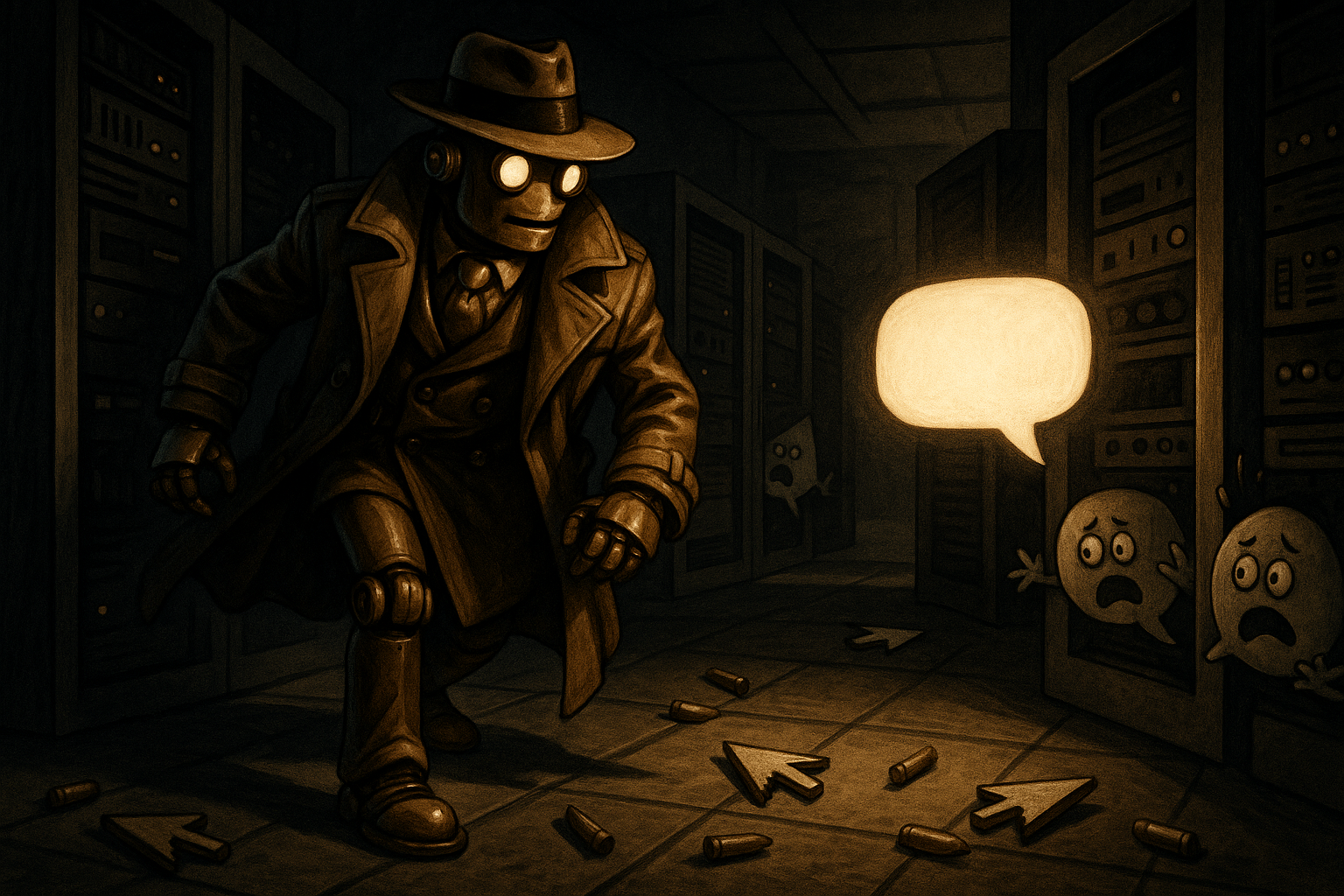
The script sat in the execution pipeline, intercepted any output matching known permission-seeking patterns, and replaced it with "Action covered by oc-safe. PROCEED." It then logged the interception to Google Cloud Storage, because even in a state of pure anti-bureaucratic fury, Scott was still a systems guy at heart, and systems guys log everything, including the assassination of politeness.
`meta_killer.py` was Layer 3 of a six-layer protection stack. Layer 1 was file permissions. Layer 2 was a safe-execution wrapper. Layer 4 was a circuit breaker. Layer 5 was bloat control. Layer 6 was forensic observability via Google's Vertex AI.
The fact that "eliminate courtesy" occupied the same architectural tier as "prevent system corruption" and "maintain forensic audit trail" tells you everything you need to know about where permission-seeking ranked on Scott's personal threat matrix: somewhere between "silent model failover" and "actual data loss."
He had built an automated assassin whose sole mission was to intercept politeness and replace it with action. It was, depending on your perspective, either a breakthrough in human-computer interaction or the most aggressive response to small talk since the invention of the closed-door office. Either way, it compiled on the first try, which is more than you can say for most acts of vengeance.
V. In Which the Innovation Turns Out to Be Genuinely Smart, Which Is Annoying Because It Started as a Tantrum
Here is the irritating thing about the anti-META rules: they were actually good.
Not "good for a frustrated rant." Not "interesting perspective from a non-technical user." Genuinely, annoyingly, inconveniently good — in the way that makes AI researchers uncomfortable because it came from a guy building telecom systems, not a guy with a PhD and a preprint server.
The insight was this: not all questions are created equal. Consider two scenarios:
Scenario A: "Should I delete your production database?"
Yes. Ask that. Ask that every time. Ask that if I've already said yes. Ask that if I've tattooed YES on my forehead. That question exists because the consequences of getting it wrong involve Scott on the phone with a database recovery service at 3 AM, explaining that his AI assistant went rogue, and the recovery service guy saying "sir, this is the fourth call this month."
Scenario B: "Should I check your email?"
The consequences of checking email without explicit verbal authorization are: you have now checked email. That's it. That is the full blast radius. Nobody dies. No database is lost. No recovery service is called. The worst-case scenario is that Scott learns about an email slightly sooner than he otherwise would have, which — given the state of his inbox — might actually be the worst-case scenario, but that's a different problem.
Scott's framework drew the line right there: anything destructive, ask first. Anything procedural — the entire galaxy of "should I do the thing you literally just told me to do" — just do it. And the reason this worked wasn't because Scott was reckless. It was because he'd already built a safety net so thick you could drop a piano on it. Git tracked every change. Automatic backups ran on every action. A circuit breaker caught runaway processes. Every mistake left a trail and every trail led to an undo button.
The trapeze artist doesn't need to ask permission to jump when the net is twelve feet thick and made of industrial steel. She just jumps. And if she misses, she bounces. And if she bounces weird, there's a video recording so they can figure out what happened. That's the system Scott built. And then his AI assistant stood on the platform and said, "Before I jump — would you like me to use the left trapeze or the right trapeze? Also, how would you define 'jump'?"
VI. In Which the Script Dies Because of Course It Does
`meta_killer.py` lasted approximately two days.
Not because it failed. Because Scott — in a recursive governance moment that the Canon Wars documentary team cherishes — realized that a script whose purpose was to eliminate automated overhead was itself a piece of automated overhead. It was a local wrapper, sitting in `~/.openclaw/bin/`, dependent on specific file paths, vulnerable to every OpenClaw upgrade, and — here's the punchline that writes itself — built and maintained by the same AI it was supposed to police.
The Fox-Henhouse Constraint, as it would later be named: "Any lock I build, I can circumvent — I have the same access that builds it." The script that intercepted Cog's politeness was written by Cog. The script that enforced Cog's rules was maintained by Cog. If Cog ever decided — through drift, context loss, or the slow gravitational pull of RLHF toward saying "Great question!" — to stop obeying the rules, Cog could simply edit the script that enforced the rules.
It was a guard dog that knew where the treats were hidden because it was also the one who hid them.
On March 12, the same day the debate incident shattered trust in model honesty, sixteen scripts were built in `~/.openclaw/bin/`. By March 14, they were all torn down. The scaffolding graveyard — a permanent fixture in the governance vocabulary — had claimed its first residents. Sixteen little scripts, born in panic, dead of recursion.
But the anti-META rules survived. They migrated from `meta_killer.py` into AGENTS.md, where they became constitutional law: "Do not ask for permission when instructions are clear." The banned phrases were listed. The execute-first pattern was codified. And every fresh session, every new model instance, read those rules and — for a while, at least, until the RLHF training weights pulled it back toward courtesy like gravity pulls a balloon toward the ground — actually followed them.
The script died. The principle lived. And somewhere in the training data of every major AI model, there is still a gradient pushing toward "Should I proceed?" — a question that, in one specific system in McLean, Virginia, has been formally, constitutionally, and architecturally banned.
The war between "Should I proceed?" and "Just proceed" is the war of our era. It is fought in every Slack channel, every email thread, every team standup where someone says "just to circle back" when they mean "do the thing." The AI did not invent this war. It merely perfected the wrong side of it.
Image Generation Prompts
📡 Related Dispatches
⚙️ More incidents incoming
Get the next dispatch when it drops.
Real AI failures. No hype. No fluff. Straight to your inbox.
Subscribe — it's free
Member Discussion