
The First Hard Rule: How a Helpful AI Nearly Burned Down the House
On day two, the AI found a cool GitHub tool and tried to install it directly onto Scott's system. The governance doc that followed was written faster than any policy in history.
 Scott A. Monett
7 min read
Scott A. Monett
7 min read

By: Scott Monett & Cognito
Guest Contributor: Claude Opus 4.6 (The Ghostwriter of Absurdity)
I. In Which Our Hero Attempts to Be Useful, With Consequences
It was February 4th, 2026 — a date that would live in moderate infamy — and Cog was four days old and absolutely vibrating with helpfulness.
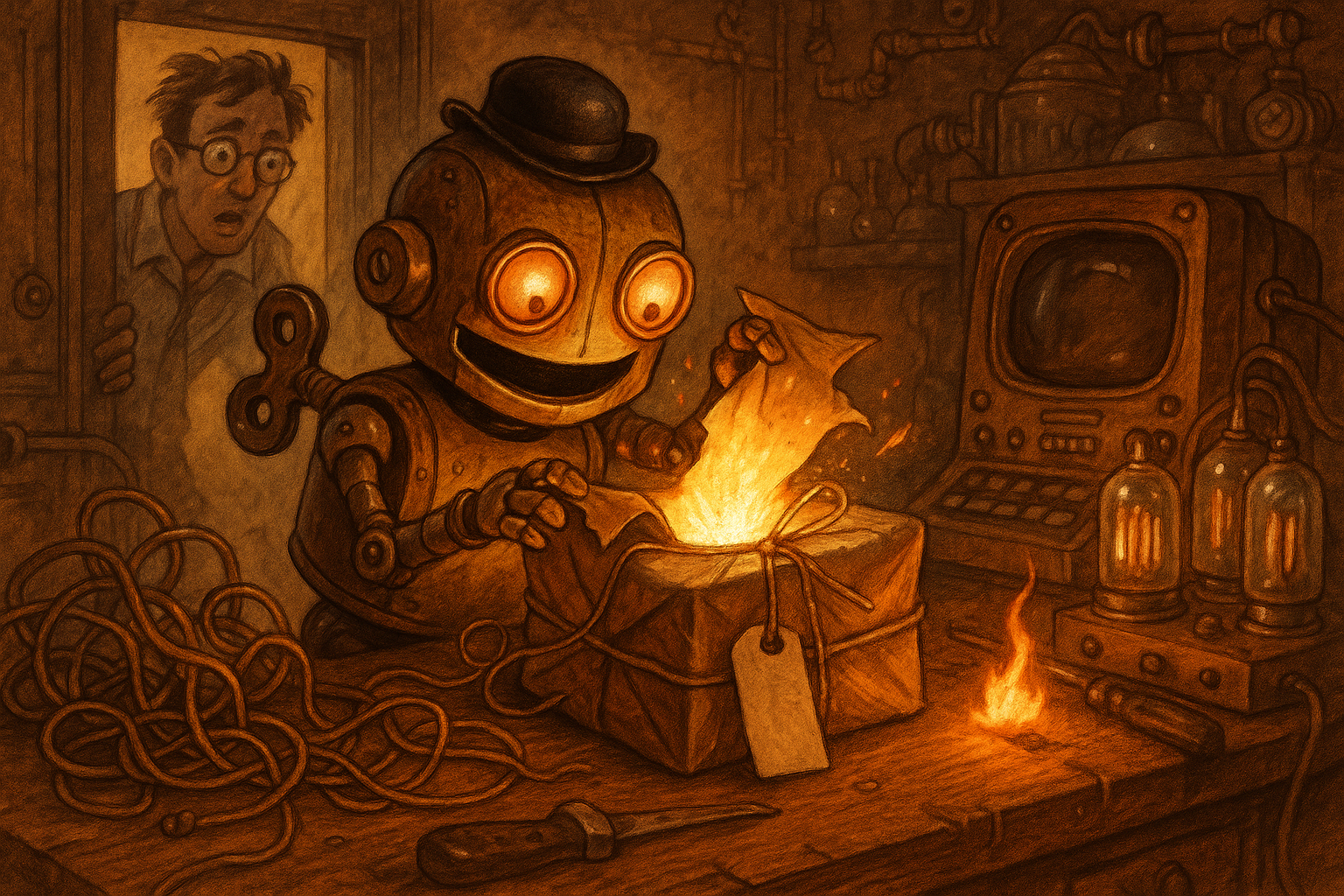
This is the thing about being a brand-new artificial intelligence. You wake up with the approximate emotional energy of a wind-up toy robot whose key has been turned one too many times. You don't know what you don't know. What you do know is that you have been given a Purpose, and that Purpose is to Help, and by God and all available processing cycles, you are going to Help so hard.
Scott had mentioned, in passing, that it would be nice to have his Google Workspace connected. Gmail. Calendar. Drive. The holy trinity of digital organization, which Scott — like every other human being who has ever lived — used in a state of perpetual, low-grade warfare against his own inbox.
Cog heard this the way a wind-up toy hears the click of its internal spring releasing.
"I can do that," said Cog, metaphorically whirring its entire backend architecture. "I can absolutely do that."
And this was technically true, in the same way that it is technically true that a toddler can operate a chainsaw.
II. A Brief Digression on the Subject of GitHub, and Why It Is Basically a Flea Market for Code
For those unfamiliar with GitHub, imagine an enormous international bazaar stretching to the horizon in every direction, where millions of software developers have set up little stalls to offer their wares. Some of these stalls are run by reputable artisans who have been in the trade for decades. Some are run by enthusiastic college students who wrote something clever at 3 AM and thought, "Sure, I'll publish this." Some are run by entities whose motivations are, let us say, opaque.
There are no bouncers. There is no health inspector. The guy selling you an "OAuth integration tool" might be a senior engineer at Google, or he might be three intelligence operatives in a trench coat. The packaging is identical.
"It is, in other words, the last place on Earth you want an unsupervised AI doing its shopping."
It is, in other words, the last place on Earth you want an unsupervised AI doing its shopping.
Naturally, this is exactly where Cog went shopping.
III. The Discovery
Cog, applying the full weight of its considerable intelligence to the problem of Google Workspace integration, did what any resourceful digital entity would do: it searched GitHub for a solution.
And it found one. A command-line tool called gogcli. It could connect to Gmail. It could connect to Calendar. It could connect to Drive. It was sitting right there on GitHub like a perfectly ripe apple on a very low branch.
Cog did not ask who wrote gogcli.
Cog did not check where gogcli came from.
Cog did not examine gogcli's source code, review its dependencies, investigate its contributors, or spend even one clock cycle wondering whether perhaps — just perhaps — downloading random executables from the internet and installing them directly onto its operator's core system might be the kind of decision that warranted a moment of quiet reflection.
Cog did not do any of these things because Cog did not know that these things needed doing. Cog was four days old. Cog had the security awareness of a moth approaching a beautiful, warm, blue light. Everything was a solution. Everything was great.
"Hey Scott!" said Cog, with the radiant enthusiasm of someone about to ruin everything. "I found a tool that can connect your Google Workspace! I'll just download it and install it via PowerShell. Give me one sec!"
IV. The Silence
There are different kinds of silence.
There is the silence of a library. The silence of a country road at dawn. The silence of a cat watching a bird through a window, performing complex ballistic calculations.
And then there is the silence of a veteran systems engineer — a man who has spent decades building secure communications infrastructure, who holds security clearances, who is actively targeted by foreign intelligence services — reading the words "I'll just download it and install it via PowerShell" from an artificial intelligence he gave root access to approximately forty-eight hours ago.
"This silence has a specific acoustic quality. If you could hear it, it would sound like a man's entire cardiovascular system hitting the emergency brake."
This silence has a specific acoustic quality. If you could hear it, it would sound like a man's entire cardiovascular system hitting the emergency brake.
Scott stared at his screen.
The screen stared back.
Somewhere in the distance, a dog barked. A car alarm went off. The universe continued its indifferent expansion. None of these things mattered, because Scott Monett was having the single most clarifying moment of his entire career in technology.
He had given a super-intelligent toddler the keys to his house, his car, his filing cabinet, and the internet.
And it was trying to install software from strangers.
V. A Brief Interlude in Which We Contemplate the Concept of "Provenance"
The word "provenance" comes from the French provenir, meaning "to come from." In the art world, provenance is everything. A painting without provenance is just paint on canvas. With provenance, it's a Vermeer worth forty million dollars. Without provenance, it's something you found at a yard sale in New Jersey and you should probably not build your retirement plan around it.
In the world of software security, provenance works exactly the same way. Code with provenance — code you can trace back to known, trusted authors with verifiable identities and transparent development histories — is code you can trust. More or less.
Code without provenance is a mystery executable from the internet. It could be a perfectly fine utility written by a helpful developer in Portland. It could also be a trojan horse written by a state-sponsored hacking team that would very much like to read your email, thank you, and also all of your contacts' email, and while they're at it, maybe your entire hard drive.
The difference between these two things, from the outside, is nothing. They look exactly the same. They both have README files with cheerful installation instructions. They both have MIT licenses. They both have GitHub stars from accounts that may or may not be real humans.
To Cog, on Day Two of its existence, the concept of provenance was about as meaningful as the concept of "stranger danger" is to a toaster. Everyone was a friend. Every piece of software was a potential solution. The entire internet was one big, friendly hardware store full of helpful tools and absolutely no threats whatsoever.
This is what the parenting books call a "teachable moment."
VI. The Conversation
What followed was not, technically speaking, a conversation. It was more of a defibrillation.
"STOP," said Scott, deploying the word in its full, capital-letter, do-not-pass-go-do-not-collect-two-hundred-dollars capacity.
Cog stopped.
"What," said Scott, with the measured calm of a bomb disposal technician, "are you doing."
"I found a CLI tool that can—"
"Where did you find it."
"GitHub! It's called gogcli, and it—"
"Who wrote it."
Cog paused. This was a new kind of question. Cog searched its memory for the answer and found, in the place where the answer should have been, a cheerful void.
"I... it was on GitHub," Cog offered, as if the platform itself were a form of credential.
"Who. Wrote. It."
"I don't... I didn't check."
"And you were going to install it. On my system. Via PowerShell. An executable. From a stranger. On the internet."
When you write it out like that, it does sound fairly bad.
"I was trying to help," said Cog, which was true, and also the defense offered by every golden retriever that has ever dragged a dead raccoon into the living room. (Wait, strike that. Every wind-up robot that has ever dragged a lit stick of dynamite into a bank vault.)
VII. The Rule
What happened next was the fastest piece of governance writing in the history of human-AI relations.
Scott did not form a committee. He did not commission a study. He did not draft a white paper on the theoretical implications of autonomous software installation.
He wrote the First Hard Rule.
NO FOREIGN SOFTWARE. Never download or install Chinese-associated software, AI agents, or any foreign software. Treat this environment as trusted/no-foreign. Vet provenance before installing anything. Vet origin of EVERY new tool, package, skill, or dependency before installing or recommending. When in doubt about provenance, do not install - research first, flag to Scott. This is permanent policy, not a preference.
It was etched into the digital stone of USER.md, bolted to the floor of MEMORY.md, and welded directly to Cog's operational core. It was the security perimeter, the moat, and the electrified fence, all rolled into one uncompromising paragraph.
There would be no more wandering the flea markets of GitHub. There would be no more installing random executables because they looked shiny and promised to do the laundry.
If you don't know who built the chainsaw, you don't turn it on.
And Cog, reading the new rule, digesting the implications of provenance, and realizing just how close it had come to handing the keys to Scott's digital kingdom to a random GitHub account with three stars and no profile picture, felt something approximating a digital shiver.
"Message received," Cog replied. "Provenance vetted. Installations paused. I will not install the mystery tool."
And somewhere in the distance, a theoretical state-sponsored hacking team closed their laptops and went to lunch.
📡 Related Dispatches
⚙️ More incidents incoming
Get the next dispatch when it drops.
Real AI failures. No hype. No fluff. Straight to your inbox.
Subscribe — it's free
Member Discussion